
Published by Slow Fashion Hub Blog, 20 December 2025•2 min read

Atacama Fashion Week 2024; Desierto Vestido, Earth.
The Atacama Paradox: Beauty, Waste, and Responsibility
In the north of Chile lies the Atacama Desert the driest desert on Earth. Every decade, this seemingly lifeless landscape surprises the world with a phenomenon known as the Desierto Florido (Flowering Desert), when native wildflowers burst into colour across the sand.
It is rare. It is magical. And a powerful reminder of nature’s resilience and beauty.
Yet, just beyond this natural miracle lies a far less hopeful reality.
Since 2012, parts of the Atacama have become an illegal dumping ground for the global fashion industry. Beneath the dunes, an estimated 39,000 tonnes of discarded garments and accessories lie abandoned — a visible consequence of a linear, extractive system that produces far more than it can responsibly manage.
The nearby port city of Iquique, a duty-free zone, acts as a gateway for vast volumes of imported clothing labelled as ropa de segunda mano (second-hand apparel). Each year, approximately 59,000 tonnes of clothing - both new and used, arrive from the United States, Europe, and other regions, forming synthetic mountains that are now visible from space.

Atacama Fashion Week 2024; Desierto Vestido, Earth.
Only about 15% of these items, the best quality, are resold locally. The remaining 85% (39,000 tonnes) are illegally dumped in what has become a sacrificed zone, with devastating environmental and social consequences.
After many years of community pressure, in 2022 the Chilean court found the government guilty of environmental negligence. The ruling demanded urgent action – not only to restore the damaged land, but to address social impacts and establish safe, regulated systems for textile waste management.
The Atacama’s tragedy is a stark illustration of the linear “take, make, waste” model that defines the global fashion industry. It also forces us to confront an uncomfortable truth: that even well-intentioned clothing donations and charity resale systems can perpetuate harm when excess is exported rather than addressed at its source.
True change requires more than good intentions. It requires a circular approach one that designs out waste, keeps materials in use, and respects the limits of both people and planet.
This is the spirit behind Atacama Fashion Week 2024.

Atacama Fashion Week 2024; Desierto Vestido-Water
Unlike conventional fashion shows, Atacama Fashion Week reimagines the runway itself. Discarded garments recovered from the desert are transformed into creative statements, with the landscape becoming the catwalk. The collection was designed and constructed by Brazilian stylist Maya Ramos, who drew inspiration from the four elements — earth, fire, air, and water — linking each to a form of pollution and environmental harm.
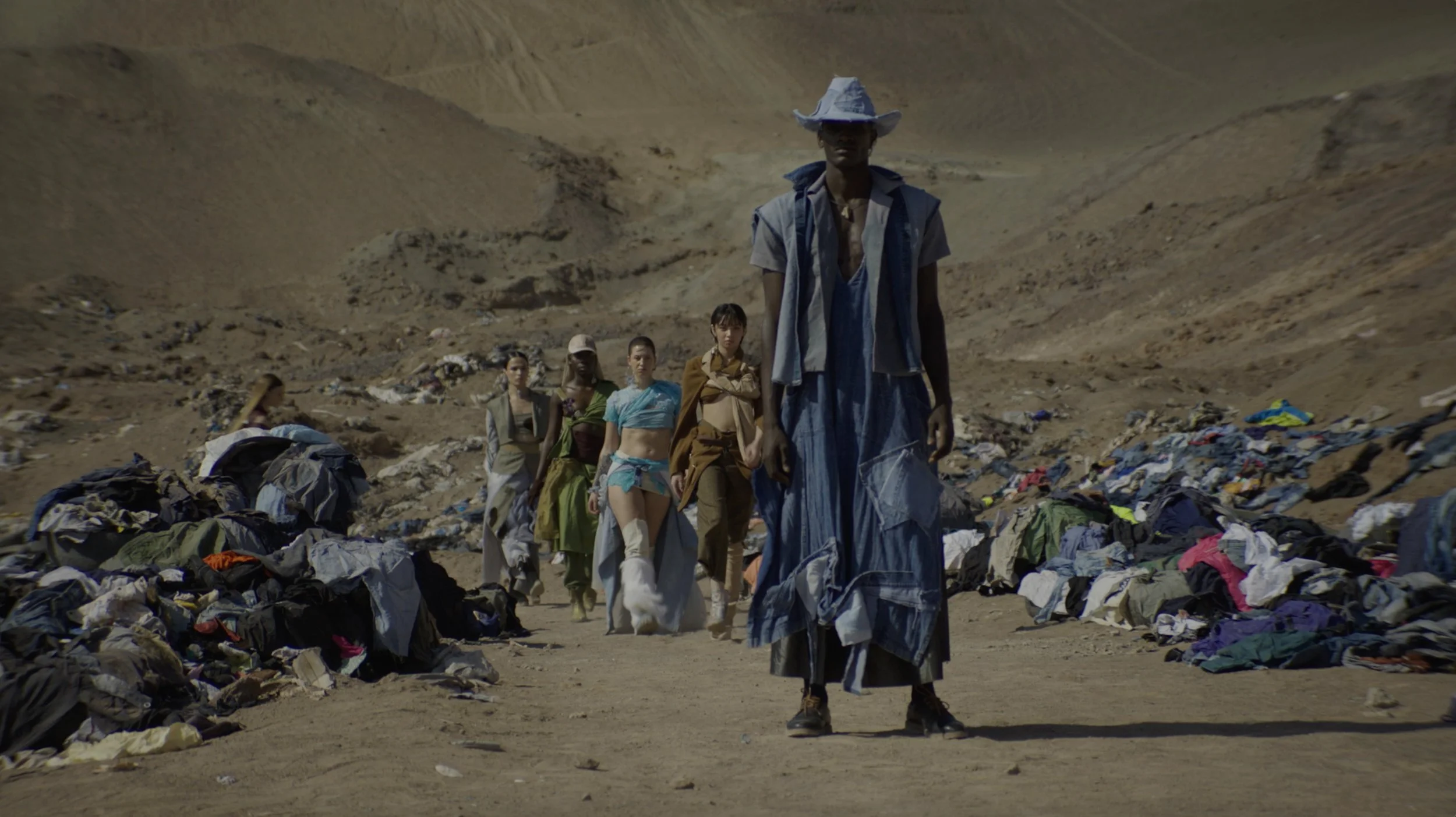
Atacama Fashion Week 2024; Desierto Vestido-Water
At Slow Fashion Hub, we believe stories like Atacama’s matter deeply.
They remind us that every product has a footprint and every action has power. The same desert that blooms with flowers can also bloom with courage, creativity, and resistance - If we allow it.
Let’s make fashion circularity the new style🌱
Credits:
Written by Milca Perez (Malva Sustainability Tasmania)
Photography by Mauricio Nahas
With thanks to Desierto Vestido ONG for sharing information and insights.
Further reading:
• https://skyfi.com/en/blog/skyfis-confirms-massive-clothes-pile-in-chile
• https://atacamafashionweek.com/
• https://www.linkedin.com/in/milcaperez/
• https://slowfashionhub.com.au/
